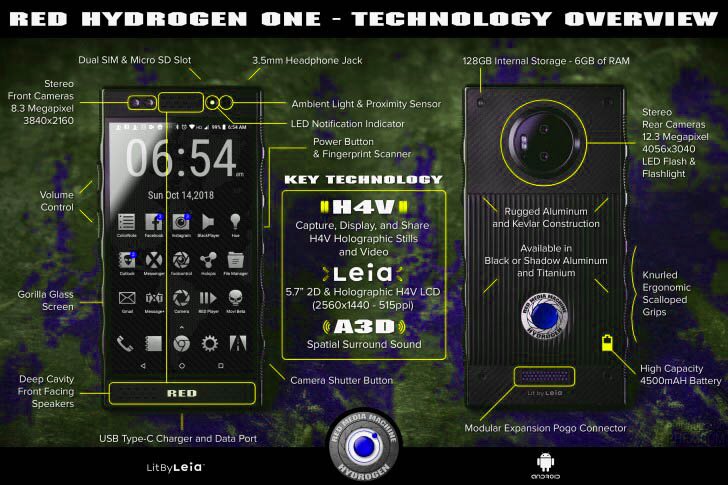

DESCRIPTION:
In 2017, Red, a manufacturer of high-end movie cameras, began to tease the public with the release of its first smartphone. The Red “Hydrogen One” was a massive smartphone that cost $1,300. It included an aluminium or titanium body, ribbed side hand grips, a “holographic” 3D display, and a modular system that eventually claimed to allow you to add a real Red camera module to your smartphone. Red called the phone a “holographic media machine in your pocket” and said it would “shatter the mould of conventional thought.”
Red’s smartphone division is now gone after the introduction of just one phone and no camera modules. Jim Jannard, the company’s creator, posted a message on the Hydrogen forums announcing the project’s demise as well as his retirement. Jannard doesn’t elaborate on his entry into the smartphone industry; he only adds, “I will be closing down the HYDROGEN project.
Red’s experience with the Hydrogen Phone was nothing but a series of disappointments and unfulfilled promises. The phone was instead made available in November 2018 since the firm was unable to meet the intended release date of “Q1 2018”. By that time, Red was selling a $1,300 smartphone with specifications that were a year old, delivering a Snapdragon 835 when other manufacturers were shipping an 845, and shipping Android 8.1 when other manufacturers were sending 9.0. The holographic display was described as “blurry and terrible” in The Verge’s review, which also pointed out that there was almost any 3D material for it.
The promise of a phone featuring Red’s camera technology would be the entire draw of a phone from Red, yet the Hydrogen One was introduced with an off-the-shelf camera component and average camera performance. The modular socket on the back of Red’s $1,300 smartphone was initially advertised as housing a “movie quality camera module,” power supplies, and storage add-ons, exactly like the company’s professional cameras. Despite this, all illustrations and references to the modules were removed from Red’s website in March 2019. These modules were never developed. At that time, Jannard recognised the end of the module programme and began teasing a second smartphone, the Hydrogen Two, which would now be available. Jannard has a tendency to follow up a disappointing news with a fresh diversion.
According to Jannard, Red’s selected ODM (Original Design Manufacturer) in China is to responsible for the Hydrogen One’s failure. In a tweet from July, Jannard stated: “We decided on an ODM in China to get the Hydrogen One ready for Foxconn’s manufacturing process. Foxconn has been excellent, but our ODM—which was in charge of mechanically packaging our design, which included new technologies, and the software integration with the Qualcomm processor—has dramatically underperformed. It has proven to be extremely difficult to get our ODM in China to complete the committed features and address known faults with the Hydrogen One. Really impossible.”
Jannard first promoted the Hydrogen Two in July. He promoted it as a type of gadget apology for customers who purchased the first Red smartphone with a new design partner. He assured those users that they will receive “substantial preferential treatment” in “delivery allocations and price” for the new phone, saying, “We completely appreciate the difficulties of our [Hydrogen One] customers.” How is Red currently making amends to Hydrogen One clients now that the Hydrogen Two is dead?
Jannard asserts that the Hydrogen One “will continue to be maintained in the future” in his post on his burial. Nevertheless, given that the phone’s most recent update was in January and that it still uses a two-year-old version of Android, we don’t hold out much hope for further support.


