INTRODUCTION :
The Poco X series usually offers a screen with a high refresh rate, a sizable, quick-charging battery, and an affordable chipset (leaving flagship performance to the F-phones). While the camera is rarely the emphasis, the X5 series checks all those boxes, and the new Pro model boasts a 108MP sensor. This time, there is also a basic phone; however, we’ll get to that later.
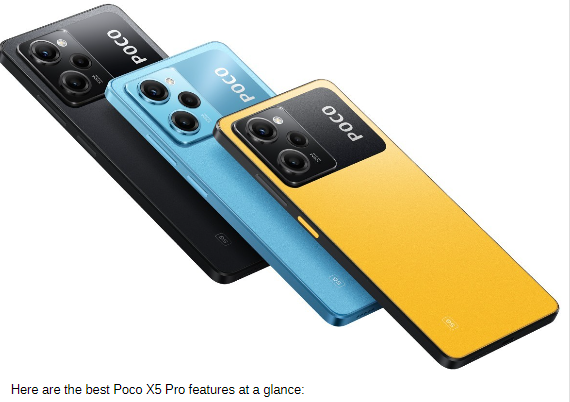
The X4 Pro from around this time last year, the Xiaomi Poco X5 Pro, is a straight replacement. The chassis has been thinned out, making it the smallest X-phone to date at 7.9mm (and third thinnest in the Poco family, beaten only by a couple of F-phones).

PROCESSOR AND RAM MANAGEMENT :
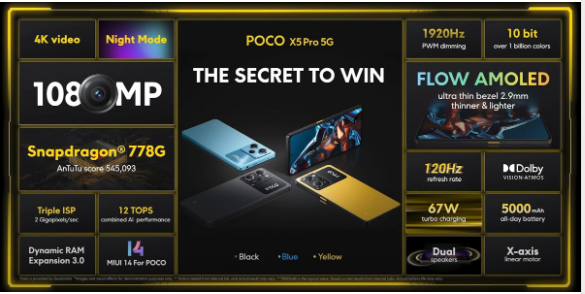
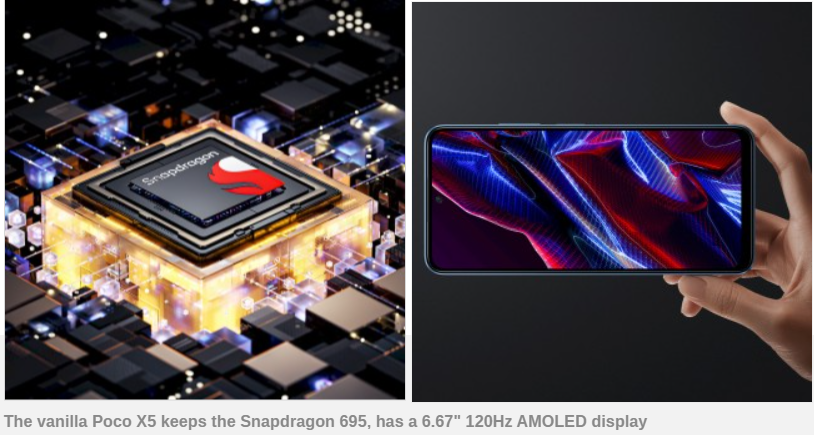
The Snapdragon 778G, a 6nm (TSMC) chip with a high-end Adreno 642L GPU, represents the generation’s primary improvement. Comparing the new chipset to the Snapdragon 695 that drove the X4 Pro, it is noticeably quicker on all fronts.
Xiaomi also increased the Pro’s base storage to 128GB this year, but maintained the RAM at 6GB. If you require more storage and memory, there is an 8/256GB version (in either case they LPDDR4X RAM and UFS 2.2 storage). The phone comes pre-installed with MIUI 14 for Poco and Android 12.

Another improvement is the monitor. Still, it is a 6.67″ AMOLED screen with 1,080 x 2,400 pixels of resolution, a refresh rate of 120 hertz, and a touch sampling rate of 240 hertz. The DCI-P3 colour system is now completely rendered in 10-bit colour. Additionally, the display is clearer, peaking at 900 nits (up from 700 nits). A high frequency 1,920Hz PWM technology controls dimming. Gorilla Glass 5 still provides protection.
CAMERA QUALITIY :
As far as the cameras are concerned, the camera setup is the same. Accordingly, the primary module has a 108MP 1/1.52″ sensor and is complemented by an 8MP ultra wide-angle module (120°), a 2MP macro camera, a 16MP camera on the front, and two other cameras.
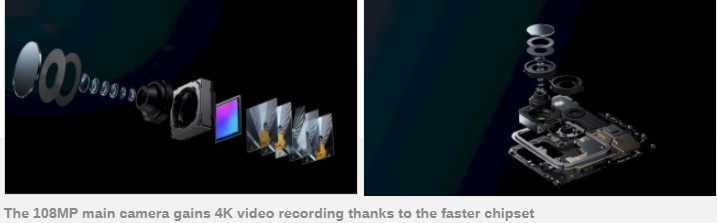
That being said, the Snapdragon 778G offers a faster ISP (2 gigapixels per second) and a more potent NPU, so the camera is not without room for improvement (12 TOPS). The most noticeable improvement is the ability to capture 4K video (up from its predecessor’s embarrassingly slow [email protected]). Additionally, using the camera has been sped up by 38% in night mode and 69% in picture taking.
CONNECTIVITY :
Additionally, the new chipset supports Bluetooth 5.2 and Wi-Fi 6 (axe) for faster local access (up from Wi-Fi 5 and BT 5.1). A 3.5mm headphone jack, an IR blaster, and (in some areas, at least) NFC are also included.
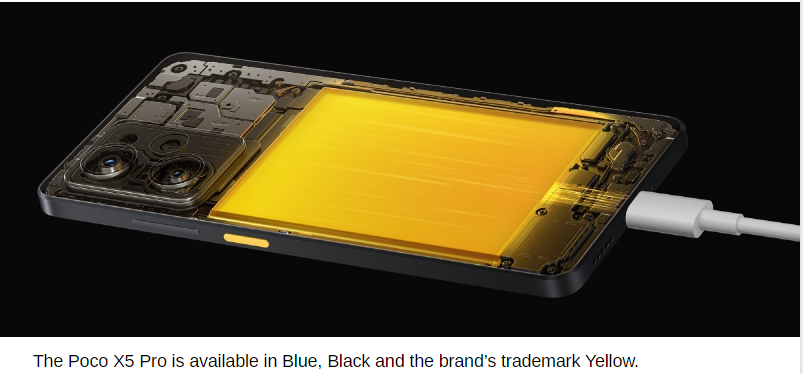
The phone also has a USB-C port, which uses the supplied charger to recharge the 5,000mAh cell at 67W.
The Snapdragon 695 chipset from the X4 Pro is retained in the Xiaomi Poco X5, which has double the basic storage at 128GB. It has an 8/256GB variant, just like the new Pro, but goes one step further by having a microSD slot that can hold up to 1TB more storage (note this phone has a hybrid card slot). The MIUI 13 for Poco version that comes preinstalled on the vanilla variant is outdated.
DISPLAY :
The monitor is 6.67″ in size and has the same 120Hz refresh rate and FHD+ resolution as the Pro. But it has an 8-bit screen and still makes use of Gorilla Glass 3. However, peak luminance is even more intense, peaking at 1,200 nits.
The camera are more in line with what a fictitious Poco X4 might have been (Xiaomi never released such a phone). It has a 48MP main camera (the chipset limits video recording to 1080p), an 8MP ultra wide (118°), a 2MP macro, and a 13MP selfie camera on the front.
BATTERY :
The battery still has the same 5,000mAh capacity, but the recharge rate has been reduced to 33W. However, you still receive a 33W charger, which can charge from 0% to 100% in 68 minutes, in the package.
PRICING & RELEASING DATE:
The X5 and X5 Pro will both be offered starting on February 7 though prices may differ by area. The following list of store partners, from which both phones will be sold, will be available:
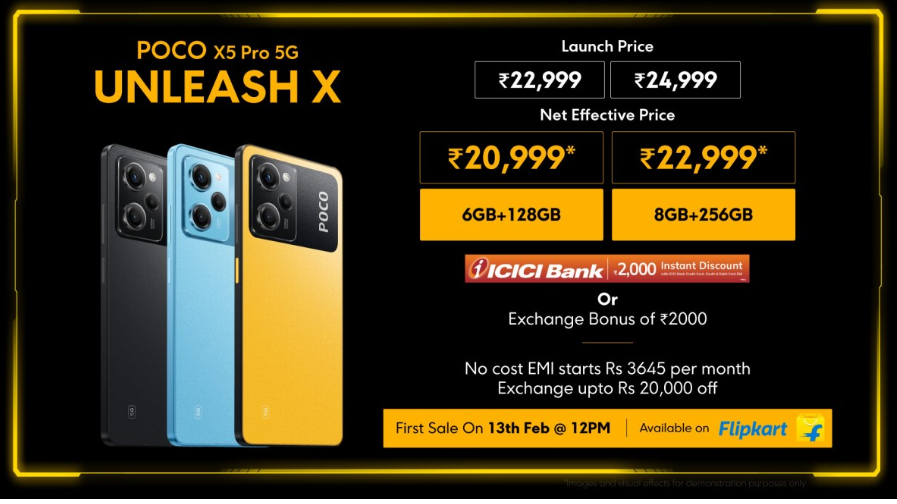
India will receive the Poco X5 Pro the following week (the rumours were right, the vanilla X5 will not be available there). The MSRP for the entry-level 6/128GB model is $23,000; the price for the 8/256GB edition is $25,000. The first deal will begin on Flipkart on February 13 at noon (next Monday). Be aware that you can save 2,000 with an exchange incentive or an instant discount (the bonus itself is up to 20,000).
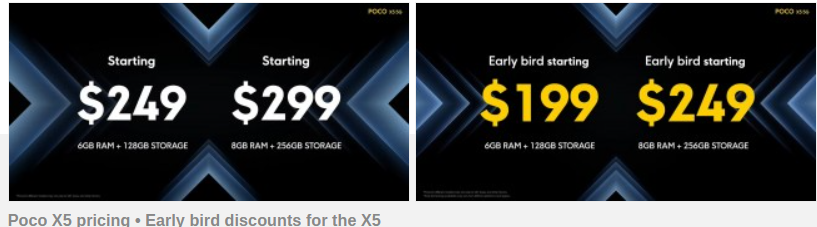
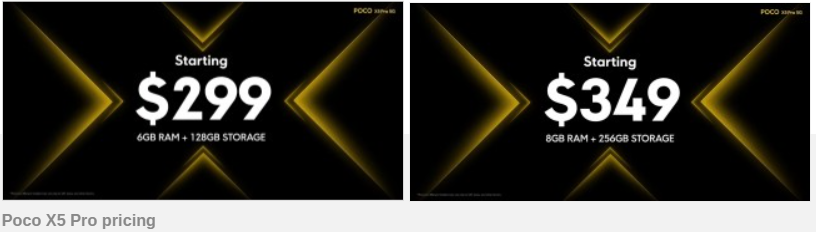
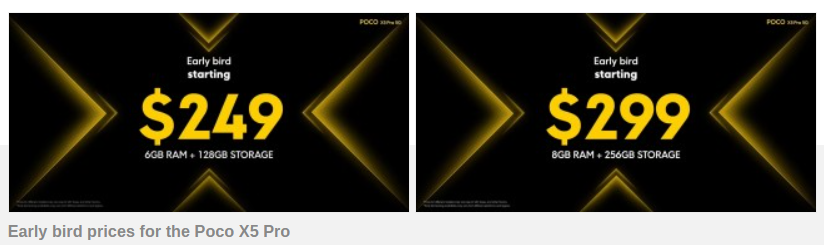
Starting at $300/€300 for the base 6/128GB variant and going up to $350/€350 for the 8/256GB model, the Poco X5 Pro is available. If you act quickly, you can purchase these for $250 and $300 and receive early bird savings on this one as well.
For $250/€250, you can purchase the standard Poco X5 with 6/128GB of memory; the 8/256GB variant costs $300/€300. However, both choices have early bird discounts that bring the price down to $200 or €200 and $250 or €250, respectively.