Introduction :
The Redmi Note 12 Pro+, which was revealed in China in October, made its premiere in India in January, and it went on sale this week in Europe. We’ve been using the Redmi Note 12 Pro+ for a few weeks, and while our comprehensive evaluation is still forthcoming, we thought we’d share some of our preliminary observations about the device now.

Design :
The 6.67″ FullHD+ “Pro AMOLED” panel of the Redmi Note 12 Pro+ is shielded by Gorilla Glass 5. It has a top luminance of 900 nits and a refresh rate of 120Hz.
The 16MP selfie camera is also punched out in the centre of the screen, but there is no biometric reader underneath because it is integrated into the power button.

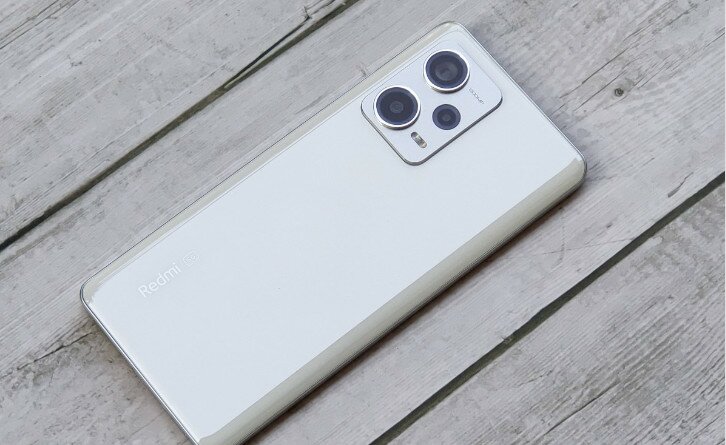
The glass back surface has a rectangular camera island with three cameras and an LED light on the opposing side. The glass cover doesn’t feel cheap, but it easily drew fingerprint smudges. If you don’t use a protective case and want to maintain its immaculate looks, regular wiping is needed.
It’s also important to note that the phone wobbles on level surfaces as a result of the protruding camera island, and the included cover doesn’t really solve the problem.

Despite having flat frames, the Redmi Note 12 Pro+’s rear panel has thin curves around the sides, making it simpler to handle than devices with flat borders. However, the Redmi Note 12 Pro+ is not a tiny phone, making it challenging to operate with one hand for those with small wrists.
The smartphone’s underside features a USB-C connection, a speaker, a microphone, and a SIM card slot. It has a 3.5mm headphone port on top, along with a second speaker, a second microphone, and an IR blaster.
There are no spaces or controls on the Redmi Note 12 Pro+’s left side frame, but there is a volume rocker and power button there. The latter device includes an integrated fingerprint reader, which we found to be quick and precise during use. We preferred it to include an in-display option, though.

When questioned why they chose a side-mounted system over an under-display one, Xiaomi responded that they did so because the former is quicker and outperforms the latter over the long haul. That doesn’t really make sense to us, considering that the Chinese company has previously released handsets with UD fingerprint scanners, even in the mid-range market.
On the plus side, the Redmi Note 12 Pro+’s side-mounted fingerprint reader does more than just open it. It features double-tap gestures that enable you to carry out a variety of tasks, such as capturing a screenshot, starting the built-in camera app, and accessing the control panel.
Display :
The 6.67″ Pro AMOLED display on the Redmi Note 12 Pro+ has a maximum luminance of 900 nits, a refresh rate of 120 Hz, and a touch sampling rate of up to 240 Hz. It is a 10-bit monitor with Widevine L1 compatibility and HDR10+ certification, enabling users to broadcast 1080p movies on OTT applications that support it.
Additionally, it supports the HDR10 and HLG codecs, and Dolby Vision and Dolby Atmos are included for an even superior audiovisual experience.

The Redmi Note 12 Pro+’s screen has pleasant haptic input, and the maximum brightness setting made the screen brilliant enough to view text outside in the sun.
It also has an Always-On Display function, but that is misleading because, contrary to what the term suggests, it doesn’t actually keep the screen on all the time after the phone is locked. Unlike Always-On Displays on other companies’ devices, the information is only displayed on the screen for about 10 seconds after the phone is closed or the display is touched. Xiaomi ought to have executed it more skillfully.
The Redmi Note 12 Pro+ supports four frame rates in total—30Hz, 60Hz, 90Hz, and 120Hz—and offers choices for 60Hz and 120Hz in the custom refresh rate menu.
When you engage with the screen, the majority of system menus and applications’ refresh rates are increased to 120Hz by default, with the exception of YouTube, which always operates at 60Hz, and Google Photos, which operates at 120Hz even when viewing 30fps movies. When you engage with Facebook and Instagram, the display updates at 120Hz, and when you are viewing a picture or streaming a video, the refresh rate drops to 60Hz.

When using the screen in the 60Hz mode, the refresh rate stays at 60Hz regardless of whether you are engaging with it or not, whereas the 120Hz mode is essentially the default option.
Speaking of games, we tried Call of Duty Mobile, Dead Trigger 2, Real Racing 3, and Sky Force Reloaded on the Redmi Note 12 Pro+. Only Dead Trigger 2 and Sky Force Reloaded could be played at 120FPS in default and 120Hz modes, while the other two remained limited to 60FPS regardless of the mode you chose.
Software and Performance :
The Dimensity 1080 SoC powers the Redmi Note 12 Pro+, which has 256GB of UFS 2.2 storage and up to 12GB of LPDDR4X RAM. Regardless of the setup you choose, the top-end variant that we got runs MIUI 13 built on Android 12 right out of the box. It presently runs MIUI 13.0.6 with the February 2023 security fix and was originally shipped with MIUI 13.0.2 Global Stable ROM with Android security patch from November 2022. Third-party applications are also pre-installed on the smartphone, though you can remove the majority of them if you’d like.
The Redmi Note 12 Pro+’s screen has pleasant haptic input, and the maximum brightness setting made the screen brilliant enough to view text outside in the sun.
It also has an Always-On Display function, but that is misleading because, contrary to what the term suggests, it doesn’t actually keep the screen on all the time after the phone is locked. Unlike Always-On Displays on other companies’ devices, the information is only displayed on the screen for about 10 seconds after the phone is closed or the display is touched. Xiaomi ought to have executed it more skillfully.

The Redmi Note 12 Pro+’s software interface is comparable to that of other Redmi devices operating MIUI 13 and Android 12. The phone’s failure to stay connected to the 5G network in India was one of the flaws that hindered the user experience. After a reset, it finally secured back to 5G after repeatedly reverting to 4G. Thankfully, the MIUI 13.0.6 upgrade resolved this.
The Redmi Note 12 Pro+ performed swiftly and smoothly all around. However, we continue to experience problems with the Disney+ Hotstar and LinkedIn applications. When using the former, the phone stutters frequently, while when using the latter, the phone’s brightness slider delays when changing the brightness in full-screen mode. With Amazon Prime Video and YouTube, we didn’t experience this problem.
Even after an hour of intense gaming, the Redmi Note 12 Pro+ managed the games we listed above well. In contrast to the 4G network, the 5G network did get warm more rapidly when watching movies.
Camera and Battery :
The Redmi Note 12 Pro+ has four cameras: a 16MP front-facing face camera, a 200MP main camera (ISOCELL HPX), an 8MP ultrawide camera, and a 2MP closeup camera. The selfie camera in the punch hole’s centre has an f/2.5 lens and can capture movies at a frame rate of up to 60 frames per second in 1080p quality.
On the other side, the 200MP camera has an f/1.7 aperture and OIS for both pictures and movies. It can record movies in 4K at 30 FPS and 1080p at up to 60 FPS. Additionally, it can take 10-bit RAW pictures. Since Xiaomi informed us that “it’s majorly due to the hardware capabilities of the processor,” the Redmi Note 12 Pro+ does not have the Clone feature that we have seen on other Redmi devices, including the Redmi K50i. Additionally, there is presently no sign that it will be introduced via a software update.

On the other side, the 200MP camera has an f/1.7 aperture and OIS for both pictures and movies. It can record movies in 4K at 30 FPS and 1080p at up to 60 FPS. Additionally, it can take 10-bit RAW pictures. Since Xiaomi informed us that “it’s majorly due to the hardware capabilities of the processor,” the Redmi Note 12 Pro+ does not have the Clone feature that we have seen on other Redmi devices, including the Redmi K50i. Additionally, there is presently no sign that it will be introduced via a software update.
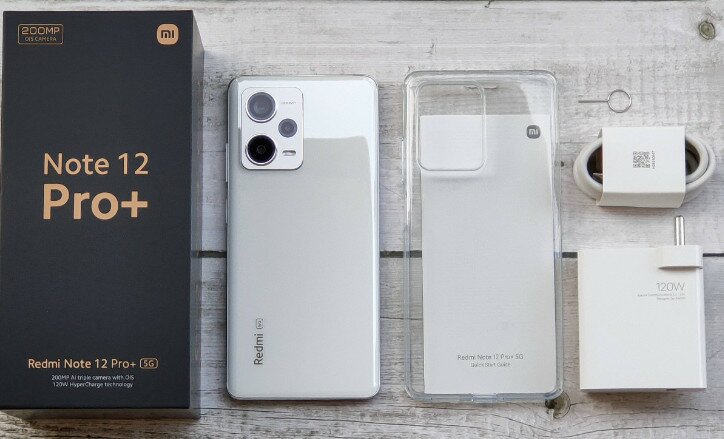
The included 120W adapter, which is marketed to charge the Redmi Note 12 Pro+’s cell from 2% to 100% in 19 minutes with boost charging activated, can be used to recharge the battery once it runs out of power.
In our tests, the battery life of the Redmi Note 12 Pro+ increased from 1% to 34% in just five minutes, 50% in nine, 55% in ten, 75% in fifteen, 91% in twenty, and 100% in twenty-four.
It increased from 1% to 32% in 5 minutes, 50% in 10, 66% in 15, 87% in 20, and 100% in 29 minutes with boost charging stopped.
Conclusion :
With the Redmi Note 12 Pro+, Xiaomi has continued to raise the price of the Redmi Note line. The company informed us that this was because it refused to make any concessions in order to keep the line at its previous price point. The basic variant of the Redmi Note 12 Pro+ with 8GB RAM and 256GB storage costs €500 ($540/INR44,400) in Europe compared to INR29,999 ($365/€340) in India.
The Redmi Note 12 Pro+ is referred to as the Note 11 Pro+’s replacement. However, since the company won’t release any smartphones from the 12i series in India to replace the 11i array from last year, it actually arrives to replace the Xiaomi 11i HyperCharge. Further confusing matters, the Note 11 Pro+, also known as the 11i HyperCharge, is available in other nations under a different name and with slightly different specifications.
With the Redmi Note 12 Pro+, Xiaomi has continued to raise the price of the Redmi Note line. The company informed us that this was because it refused to make any concessions in order to keep the line at its previous price point. The basic variant of the Redmi Note 12 Pro+ with 8GB RAM and 256GB storage costs €500 ($540/INR44,400) in Europe compared to INR29,999 ($365/€340) in India.
The Redmi Note 12 Pro+ is referred to as the Note 11 Pro+’s replacement. However, since the company won’t release any smartphones from the 12i series in India to replace the 11i array from last year, it actually arrives to replace the Xiaomi 11i HyperCharge. Further confusing matters, the Note 11 Pro+, also known as the 11i HyperCharge, is available in other nations under a different name and with slightly different specifications.
Source