Introduction :
The Samsung Galaxy S23, one of the best tiny phones in the world, has gotten quicker, sturdier, more connected, and with more battery life. The Galaxy S23 remains as small, light, and appealing as ever, and we anticipate it to become a fan favourite in the compact sector.
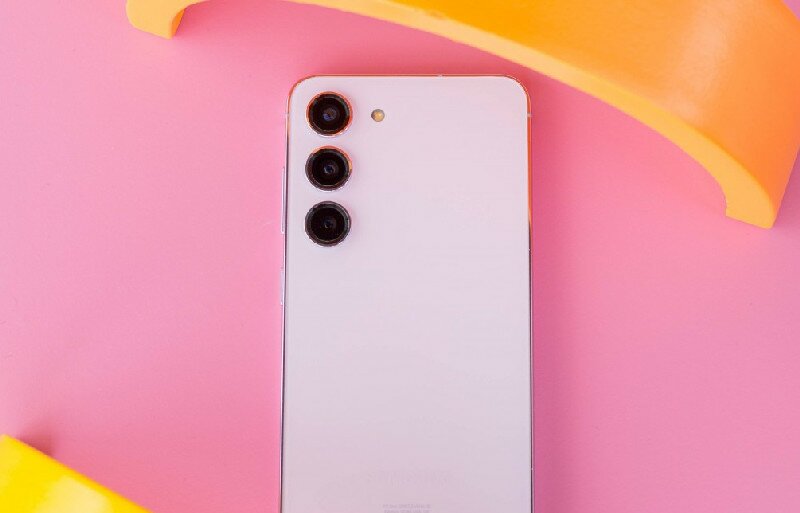
The new Galaxy S23 models have a more streamlined look, which is the first thing you’ll notice. There is no longer a contour-cut camera housing; instead, there are three little rings for the lenses. Furthermore, the front and rear glass panels have been upgraded to Gorilla Glass Victus 2 sheets for increased drop protection.
For the first time in a long time, the complete Galaxy S23 family is powered by a Qualcomm chipset, so you don’t need to import a Qualcomm-powered phone if you don’t like the Exynos platform (we don’t blame you). Even better, Samsung employed a unique overclocked version with greater CPU and GPU rates for the Galaxy S23 phones. The new versions also rely on next-generation memory chips manufactured by Samsung.
The triple camera on the rear has not been improved; the 50MP OIS primary, 10MP 3x telephoto, and 12MP ultrawide cameras remain same. The selfie camera has been enhanced to 12MP and enables Super HDR, while focusing and 4K shooting remain options.
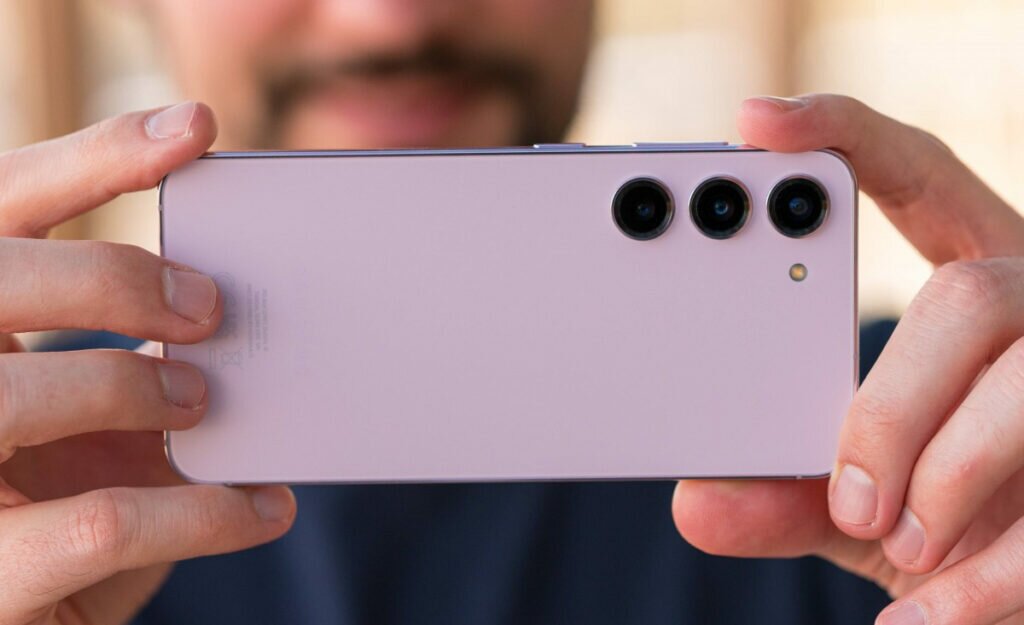
The Galaxy S23 is a textbook flagship; there are no two ways about it; it has the build and aesthetics, screen, CPU, and cameras of a premium smartphone. The only things we think are lacking are 10-bit colour depth for the screen, which many high-end phones have, and Ultra Wideband capability, which would have allowed support for the SmartTag+. Of course, ordinary Bluetooth-enabled SmartTags can still be used.
The Samsung Galaxy S23 is a small boost over the Galaxy S22, and we doubt that many S22 users will be enticed to upgrade. However, it offers more than enough new features over the Galaxy S21 and previous models to make it an appealing proposition.
Design, build quality :
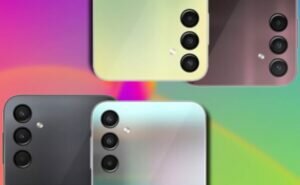
The Samsung Galaxy S23 is a stunning smartphone with a straightforward design. It’s also a tough, waterproof, and lightweight device, which is a winning combo. This year, Samsung chose a cleaner design that is available in Phantom Black, Cream, Green, Lavender, Graphite, and Lime – not as many as the Galaxy S22, but still plenty.
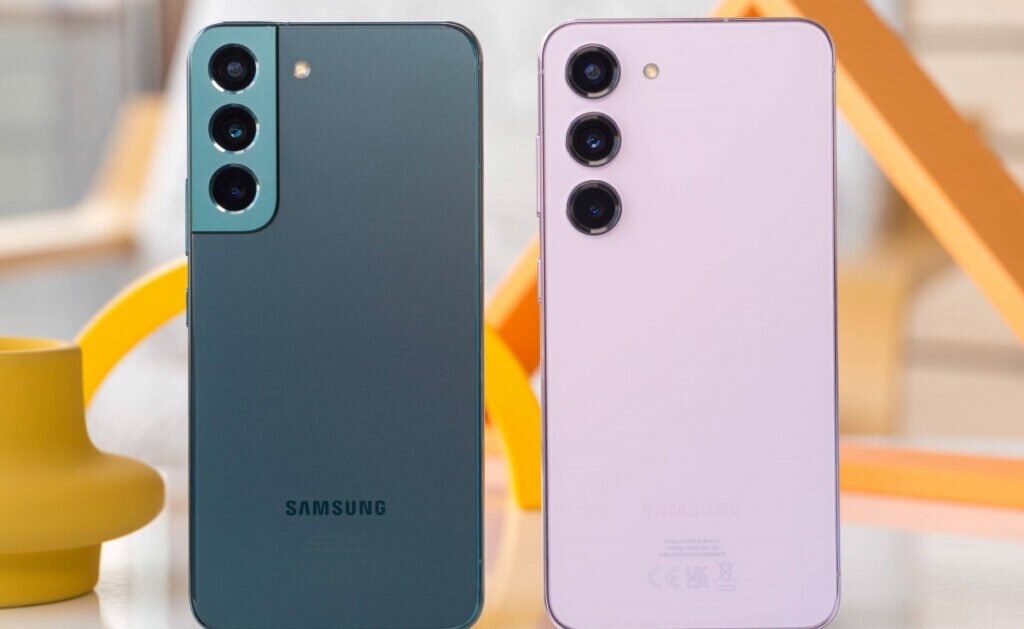
We have the Galaxy S23 in Lavender, which is a pretty nice colour that is easy on the eyes and isn’t as popular on the market.
The Gorilla Glass Victus 2 panels, the protected aluminium frame, and the retiring contour-cut camera housing in favour of a clean flat back are the most noteworthy hardware features of the new Galaxy S23.
Curved panels remain restricted to the Galaxy S23 Ultra variant, which is fine. The flat front and back surfaces fit the Galaxy S23’s size and form perfectly. The new Victus 2 glass offers better drop performance against rough surfaces like concrete, increasing the likelihood of the S23 surviving accidental drops on concrete, terracotta, granite tiles, and so on.
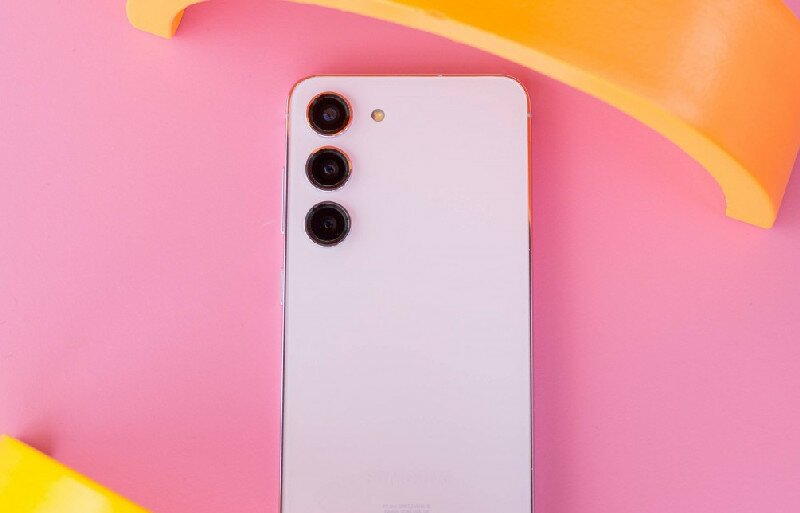
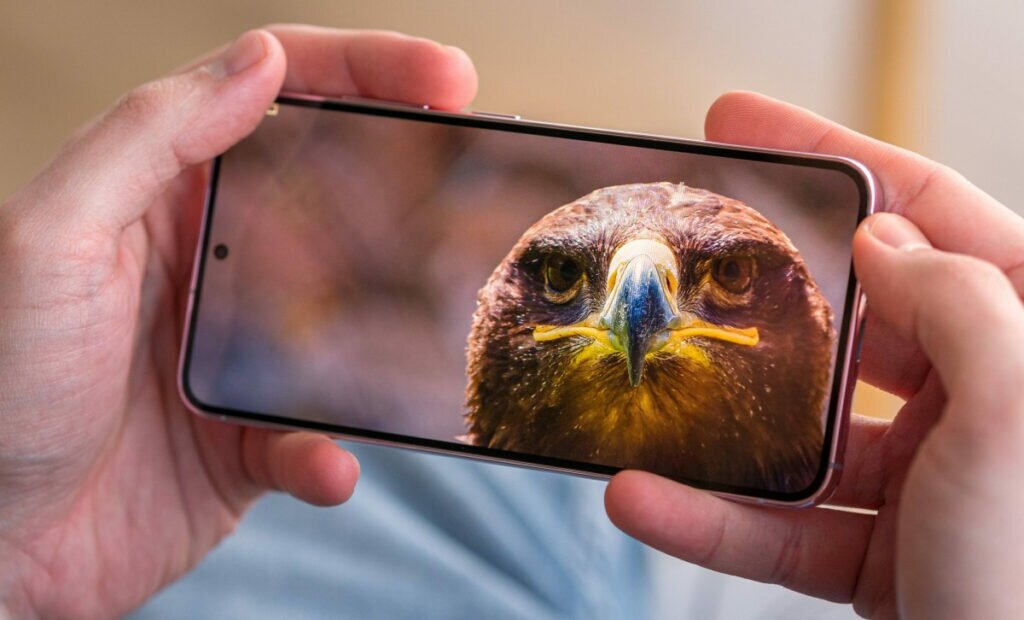
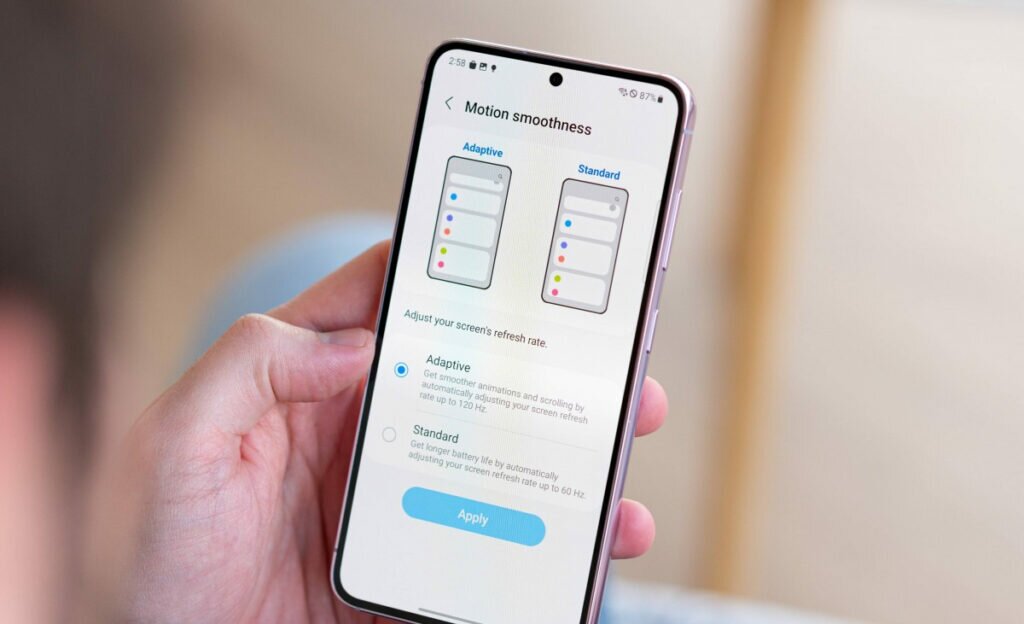
The Great Dynamic AMOLED 2X Screen :
Battery Health :
The Galaxy S23 is powered by a 3,900mAh battery, which means it has 200mAh more capacity than the cell inside the Galaxy S22, but still 100mAh short of the Galaxy S21’s.
Still, the Galaxy S23 scored a 101h endurance rating on our battery life test and showed outstanding performance across all tests – call, web browsing and video. It bested both the Galaxy S21 and S22, as well as the iPhone 14 and 14 Pro.
The Galaxy S23 has a little better standby performance (251h) than the Galaxy S22 (239h, Exynos), however it still performs somewhat worse than the Galaxy S21 (319h, Exynos).
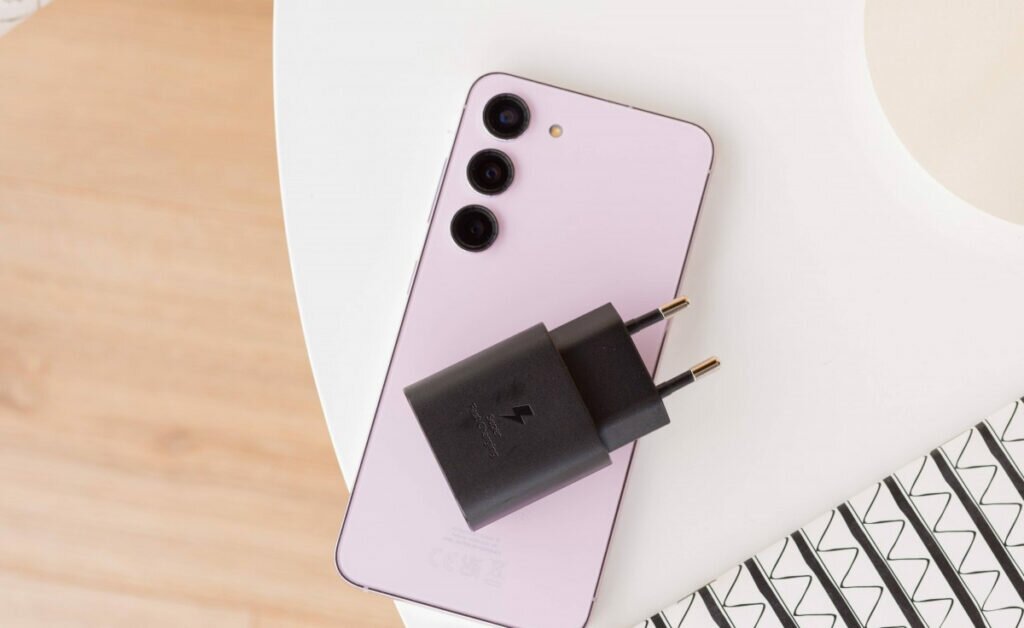
Samsung delivers the Galaxy S23 without a charger, so if you haven’t already, or if your retailer/carrier hasn’t given you one, you’ll need to purchase Samsung’s 25W power adapter for best results.
The adapter charges 30% of the Galaxy S23 battery in 15 minutes and 57% in another 15 minutes.
Camera Qualities :
The Samsung Galaxy S23 has the same three-camera system as the Galaxy S22 (wide, UW, 3x tele), but it has a new selfie camera with a higher-resolution sensor.
A 50MP Samsung S5KGN3 1/1.57″ sensor with 1.0m pixels and a Tetracell filter is used in the primary camera. This sensor is combined with an OIS-stabilized 23mm f/1.8 lens, and dual-pixel PDAF is offered. This camera, like the one on the Galaxy S22, saves photographs in 12MP resolution rather than the usual 12.5MP. It also has a large field of view.
The telephoto lens is equipped with a 10MP Samsung S5K3K1 sensor. It has individual pixels at 1.0m and is 1/3.94″ in size. It has the same lens as the Galaxy S22, a 69mm f/2.4 stabilised lens (OIS) with PDAF capability.
The ultrawide camera uses a Sony IMX564 1/2.55″ sensor with 1.4m pixels and a 13mm f/2.2 lens. The focal point is fixed at infinity.
Finally, the new selfie camera is equipped with a 12MP Samsung S5K3LU sensor with a 1.12m pitch and a 25mm f/2.2 lens. As is customary, dual-pixel PDAF is present. Many prior versions, including the Galaxy S22, employed 10MP front-facing cameras.
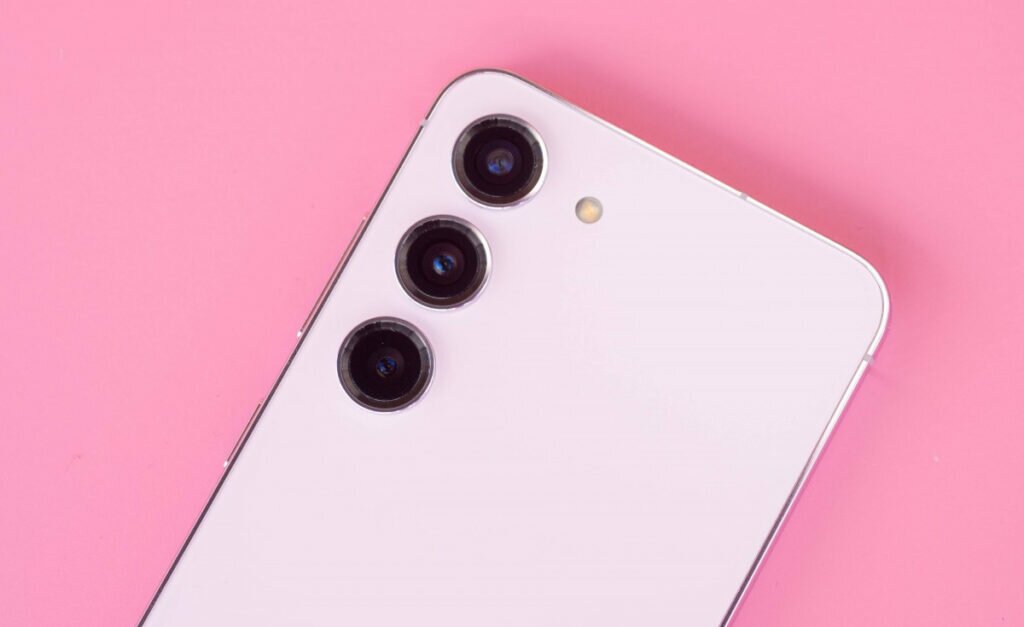
The camera app is identical to what you’d see on any modern Samsung phone. Swiping left and right switches between all possible options, and you can rearrange or delete some of them from the viewfinder. Vertical swipes in either direction toggle between the front and back cameras.
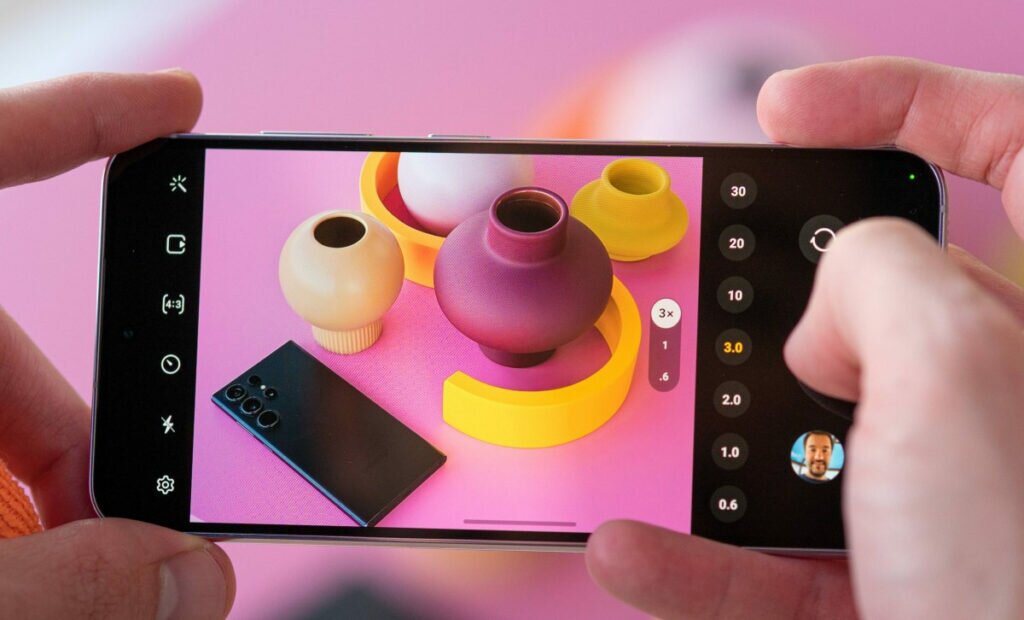
On the viewfinder, there are three zoom shortcuts:.6x, 1x, and 3x. Tapping on any of these reveals additional zoom levels: 2x, 10x, 20x, and 30x.
The primary camera’s full resolution mode is activated via the aspect choices, which is a bit confusing.